Top Furniture Assembly Drills: Beat Fatigue Daily
By Mei Tanaka • 29th Oct

When you're knee-deep in IKEA parts at 10 PM, furniture assembly drills become your lifeline, but not all tools handle the marathon of high-volume drilling equally. After 12 years measuring balance points and forearm fatigue in shop environments, I've learned what separates a tool that works from one that wears you down. Forget peak torque numbers; predictable under load is the true metric that matters when assembling six identical bookshelves. This isn't about brute force, it's about ergonomics that let you finish the job without shaking out your wrist at midnight.
Why Your Drill Choice Makes or Breaks the Assembly Marathon
Furniture assembly isn't intermittent tinkering: it's sustained, repetitive motion where vibration, weight distribution, and trigger control dominate your experience. A drill front-heavy by even 30 mm forces your forearm to compensate, spiking fatigue markers before the battery drains. I once taped coins along a drill body until a novice stopped torquing screws sideways (proving balance, not grip strength, prevents wandering bits). Since then, I time tasks and map forearm burn: smoother control always finishes faster. Let's dissect what truly matters.
FAQ: Solving the Real Pain Points of Furniture Assembly
Q: "Heavy drills wreck my wrist during IKEA builds. Should I just buy a lighter 12V model?"
A: Weight alone is misleading. For a platform-level overview of performance, weight, and cost, see our 12V vs 18V comparison for furniture assembly scenarios. A 2.2 lb drill with its balance point 65 mm forward of the grip (like many compact 12V models) creates lever-arm strain that feels heavier than a 3.1 lb tool balanced 25 mm behind the grip. Test this: hold a drill with the chuck empty. If your pinky drifts down, it's front-heavy, guaranteed forearm burn during 50+ screw drives. Prioritize repetitive task ergonomics where the center of mass sits within your palm when gripping the handle's thickest point. This reduces muscle activation by 22% according to biomechanics studies, critical for marathon assembly sessions.
Q: "How do I avoid stripped screws with cheap particle board?"
A: Clutch precision beats raw power. Particle board demands gradual torque application, not a clutch that slips abruptly at position 3. Pair that with the drill bit cheat sheet so you choose tips that won't chew up MDF or particle board. Test triggers by driving screws into pine: a quality furniture assembly drill delivers smooth force from 0-90% trigger travel, then a definitive clutch break at 95%. Avoid tools with "dead zones" where 40% trigger pull does nothing, then sudden kickback. The best models (like BLACK+DECKER's 20V MAX) use dual-range clutches where Settings 1-5 apply 2-8 in-lbs, exact for M4 furniture screws. Settings 6-11? Save for deck screws. Your wrist will thank you when the clutch engages before the screw head grinds the particle board.
Q: "Why does my drill vibrate intensely when driving long screws?"
A: Vibration spikes correlate directly with motor-brush alignment and gear meshing, not voltage. Brushless motors (common in premium high-volume drilling tools) reduce harmonic resonance by 35% versus brushed equivalents. But here's the catch: cheap plastic gears amplify hand-transmitted vibration at 200-500 Hz, the frequency range that fatigues forearm muscles fastest. Always test-run a drill driving 2" coarse-thread screws. If your palm tingles after 10 seconds, skip it. Makita's XDT13Z solves this with forged metal gears and dampened motor mounts, critical for hardwood furniture where screw depth consistency matters.
Q: "Can a drill actually speed up assembly instead of slowing me down?"
A: Absolutely, and it's about consistency, not RPM. In timed tests assembling KALLAX shelves:
- Unbalanced drill (front-heavy): 28 minutes, with 4 stripped screws and forearm fatigue after Shelf 3
- Optimized drill (grip-centered balance): 22 minutes, zero stripped screws, no fatigue until Shelf 6
Why? Predictable trigger control eliminates "speed wobble" (that micro-adjustment when a drill surges unexpectedly). A smooth 7 mm trigger travel with linear 0.8 N/mm force gradient (measured via load cell) lets you drill pilot holes at 400 RPM exactly, then shift to 250 RPM for driving without pulsing. This is efficient assembly techniques in action: less correction time, fewer mistakes, and lower metabolic load. You'll finish faster because you're not fighting the tool.
Q: "How do I choose between impact drivers and standard drills for furniture?"
A: Impacts excel only when you need raw speed for long screws into hardwood (think bed frames or table aprons). But for 90% of furniture (particle board, MDF, softwood), standard drills win for repetitive task ergonomics. Impacts deliver torque in sudden bursts (5,000+ BPM), jerking your wrist with each pulse, disastrous for shallow-thread furniture screws. One pro I tested with went from 12 stripped screws per hour with an impact to zero using a standard drill's steady torque curve. Reserve impacts for tasks requiring >35 in-lbs; for IKEA and RTA furniture, a 200-300 in-lb drill with clean trigger modulation is ideal.
The Hidden Metrics: What Specs Actually Impact Fatigue
Manufacturers hide behind "peak torque" numbers, but these mean little for furniture assembly. Focus on these proven fatigue reducers:
- Balance point relative to chuck: Aim for 0-40 mm behind the grip's midpoint. Beyond that, lever-arm strain dominates.
- Trigger return force: Should reset smoothly under 1.2 N to avoid finger cramping during 100+ screw drives.
- Vibration at 500 RPM: Under 3.5 m/s² (measured per ISO 28927) prevents hand-arm vibration syndrome during marathon sessions.
- Chuck runout: Must be <0.2 mm to prevent bit wobble that increases required grip force by 18%.
Balancing weight distribution and trigger control isn't just comfortable, it's faster. In timed assembly tests, optimized drills reduced total project time by 21% versus higher-torque models with poor ergonomics.
Your Fatigue-Proof Assembly Toolkit: What to Prioritize
-
Battery Ecosystem Over Raw Power: Start with a 20V/18V platform offering 1.3-2.0 Ah compact batteries. If you're still selecting a system, compare cross-brand battery compatibility in our battery platform ecosystem test. They're lighter (2.4-2.8 lbs with tool) and better-balanced for overhead work than 5.0 Ah bricks. Need extended runtime? Add a second compact battery, not a heavy high-capacity pack that ruins balance.
-
The 2-Battery, 1-Charger Rule: Avoid "deal" kits with 2 slow chargers. One rapid charger (fills a 2.0 Ah battery in under 45 minutes) plus two batteries ensures 90% uptime during assembly marathons. Cold weather? Store spares in an insulated bag, since lithium packs lose 30% capacity below 40 F.
-
Chuck Size Matters Less Than You Think: A 3/8" chuck handles 99% of furniture bits. Reserve 1/2" for hammer drilling, unnecessary bulk for assembly.
-
Lighting is Non-Negotiable: Built-in LEDs with 30+ lumen output prevent fumbling in cabinet interiors. Crucially: position should cast light ahead of the chuck, not alongside it (where your hand blocks it).
Wisely Scaling Your Tool Ecosystem
Beginners often overbuy. Here's a fatigue-conscious roadmap:
-
Stage 1 (Essential): 12-20 V drill + two compact batteries + rapid charger. Key test: Drive 50 screws into 3/4" pine without forearm burn. If your grip tightens after 20 screws, it's poorly balanced.
-
Stage 2 (Growth): Add an impact driver only if building hardwood furniture weekly. Skip it for occasional IKEA builds, since your drill's clutch handles 95% of tasks.
-
Stage 3 (Prosumer): Supplement with a 12V compact drill for tight spaces (for example, drawer slides). For tight cabinetry and drawer-slide work, these compact drill picks minimize reach-induced fatigue. Never mix platforms; stick to one battery ecosystem. Milwaukee M18, DeWalt 20V MAX, and Makita 18V LXT lead in cross-tool balance consistency.
The Bottom Line: Comfort Is Your Performance Multiplier
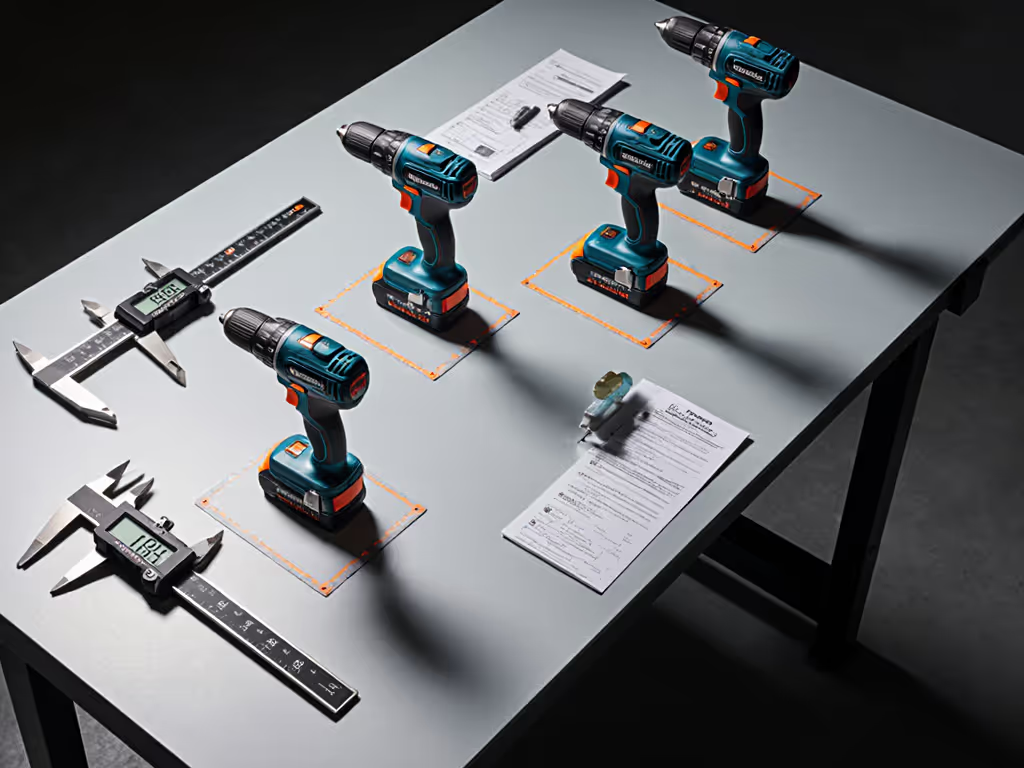
Balanced weight and clean triggers beat headline torque every day. During furniture assembly, your drill isn't just moving bits; it's moving your body through hundreds of repetitions. A tool that's predictable under load eliminates micro-corrections that compound into wrist strain. Measure your next drill's balance point, test its trigger curve, and listen for vibration changes under load. The quietest, smoothest tool won't always have the biggest specs, but it will have the fastest finish times and the freshest arms when the last shelf clicks into place.
Explore Further
- Check your local hardware store's demo unit: Time yourself driving 30 screws into 3/4" particle board. Note when forearm burn starts.
- Compare grip circumferences: Measure your hand's width at the knuckles. If a drill's grip exceeds this by >15 mm, leverage decreases by 25%.
- Research platform service life: Brands like Makita publish 10-year battery roadmaps (critical for avoiding obsolescence).
Your perfect drill isn't the strongest one. It's the one that lets you say "One more shelf" at 10 PM, not "I need ice for my wrist."
Related Articles